
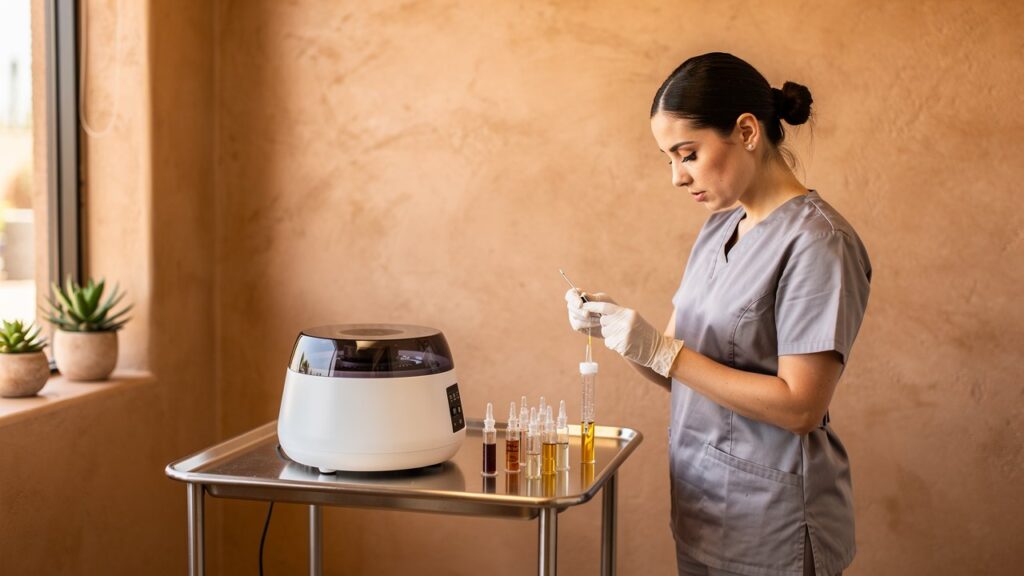
At Sonoran Skin Renewal in Scottsdale, Polly West, FNP-C uses platelet rich fibrin — PRF — for facial rejuvenation and hair restoration protocols. PRP (platelet rich plasma) has been used in aesthetics for over a decade and is well-established. PRF injections Scottsdale patients receive are newer, produce a higher concentration of growth factors, and release them more gradually. Here’s what makes them different and how to know which one fits your goals.
What PRP and PRF Actually Are
Both PRP and PRF start with a blood draw. A small amount of your own blood is spun in a centrifuge to separate platelets and growth factors from red blood cells. The meaningful differences come from how that centrifuge is used and what you get out of it.
PRP uses a higher-speed spin with an anticoagulant — typically sodium citrate — added to the tube. The result is a liquid serum containing platelets at roughly two to five times the normal concentration in whole blood. It disperses quickly when injected.
PRF injections Scottsdale protocols use a slower centrifuge speed and no anticoagulant. The result is a fibrin gel — denser, richer in platelets (typically five to ten times normal concentration), and containing a broader mix of white blood cells. That fibrin matrix is what sets PRF apart.
The One Difference That Changes Everything
The fibrin scaffold in PRF is not a minor technical detail — it’s the clinical advantage. In PRP, growth factors disperse within hours of injection. In PRF, the fibrin matrix holds them in the tissue, releasing them gradually over seven to ten days. That sustained signaling to collagen-producing fibroblasts and new blood vessel formation is what produces more prolonged biological activity from the same injection volume.
PRF was first described by Dr. Joseph Choukroun in 2001 as an advancement in regenerative medicine. In the years since, clinical comparisons have consistently shown that PRF’s fibrin scaffold produces more extended growth factor activity than PRP. The gel consistency also means it stays precisely where it’s placed after injection — which matters when treating the under-eye area or fine lines where placement accuracy is critical.
How PRF Is Used at Sonoran Skin Renewal
Polly uses PRF at Sonoran Skin Renewal in two primary applications: facial rejuvenation and scalp hair restoration.
For facial treatment, PRF can be injected under the eyes to address hollowing and fine lines, applied topically after Morpheus8 or RF microneedling to support skin repair and amplify collagen outcomes, or used as a standalone biostimulator for patients who want natural results without synthetic fillers. The combination with energy-based treatments works because microneedling creates channels that make the skin temporarily more receptive to the PRF growth factors.
For hair restoration, PRF is injected into the scalp at the level of the hair follicle. The sustained release of growth factors — including PDGF, VEGF, and TGF-β — supports follicle activity and can slow thinning or encourage regrowth in early-stage hair loss.
Want to know if PRF is right for your goals? Schedule a consultation at Sonoran Skin Renewal and Polly will give you a direct assessment.
What PRF Treats — and Where It Outperforms PRP
For facial rejuvenation, PRF targets under-eye hollowing and the tear trough area, fine lines around the mouth and eyes, skin quality, hydration, and radiance, and post-treatment recovery after Morpheus8 or microneedling. It’s particularly well-suited to areas where a slow-release approach produces more natural-looking improvement than a single acute injection.
For hair restoration, PRF injections into the scalp produce results that typically require three sessions spaced four to six weeks apart. The treatment is appropriate for early-stage thinning — patients who still have active follicles that can respond to growth factor stimulation. It’s not a solution for complete hair loss where follicles are no longer viable. The clinical background Polly brings as an FNP-C allows her to assess whether PRF is actually appropriate for a patient’s hair loss pattern before recommending it.
The Treatment Process: What Happens During a PRF Session
The process takes about 45 minutes from blood draw to injection. Ten to twenty milliliters of blood are drawn from your arm, spun at a calibrated speed for about 12 minutes, and then used immediately. Unlike PRP, which has a longer usable window, PRF must be injected quickly after centrifugation because the fibrin begins forming during the spin and continues setting after processing.
Discomfort is minimal. Facial PRF injections are done with topical numbing cream applied beforehand. Scalp treatments use a local anesthetic. You may see mild swelling or bruising at injection sites for two to three days post-treatment. There’s no meaningful downtime, and most patients return to normal activity immediately.
Combining PRF with exosome therapy is something Polly considers for patients who want to push the regenerative response further. Both treatments work through different biological pathways, and they complement each other well when the patient’s goals call for it.
What Results to Expect and How Long They Take
PRF results build gradually. The fibrin matrix releases growth factors over the first seven to ten days, but the collagen response that produces visible improvement continues for four to six weeks after injection. Most patients notice improved skin quality — hydration, texture, and a subtle reduction in fine lines — within four to six weeks of treatment.
For hair restoration, measurable improvement in density typically becomes visible after two to three sessions. Full assessment is usually done at the six-month mark, when the treatment series is complete and the scalp has had sufficient time to respond. Patients who start PRF earlier in the hair loss process consistently see better results than those who wait until thinning is advanced.
Frequently Asked Questions About PRF Injections in Scottsdale
What’s the biggest practical difference between PRP and PRF?
The duration of growth factor activity. PRP disperses quickly — the active signaling period is measured in hours. PRF’s fibrin scaffold extends that activity over days, which produces a more sustained collagen stimulus from the same treatment. For most aesthetic applications, that extended activity translates to better and longer-lasting results.
How many PRF sessions will I need?
For facial rejuvenation, most patients do two to three sessions spaced four to six weeks apart for an initial series, then one maintenance session every six to twelve months. For hair restoration, three sessions spaced four to six weeks apart is the standard protocol before assessing results at six months.
Can PRF replace dermal fillers?
No — PRF and fillers do different things. Fillers add volume immediately. PRF stimulates your body to produce collagen and improve skin quality gradually. They’re complementary, not interchangeable. Patients who want both volume restoration and skin quality improvement can benefit from combining them, sequenced appropriately.
Is PRF safe for all skin types?
Yes. Because PRF uses your own blood, there’s no risk of allergic reaction to a foreign substance. It’s well-tolerated across skin types and tones. Patients on blood thinners or with certain platelet disorders may not be good candidates — Polly reviews medical history during consultation to confirm eligibility before recommending treatment.
Ready to Get Started?
Sonoran Skin Renewal offers PRF injections in Scottsdale as part of facial rejuvenation and hair restoration protocols. Polly will assess your concerns and tell you whether PRF is the right fit — or whether a different treatment would serve you better.
Book Your Consultation or call us at (480) 808-8499.